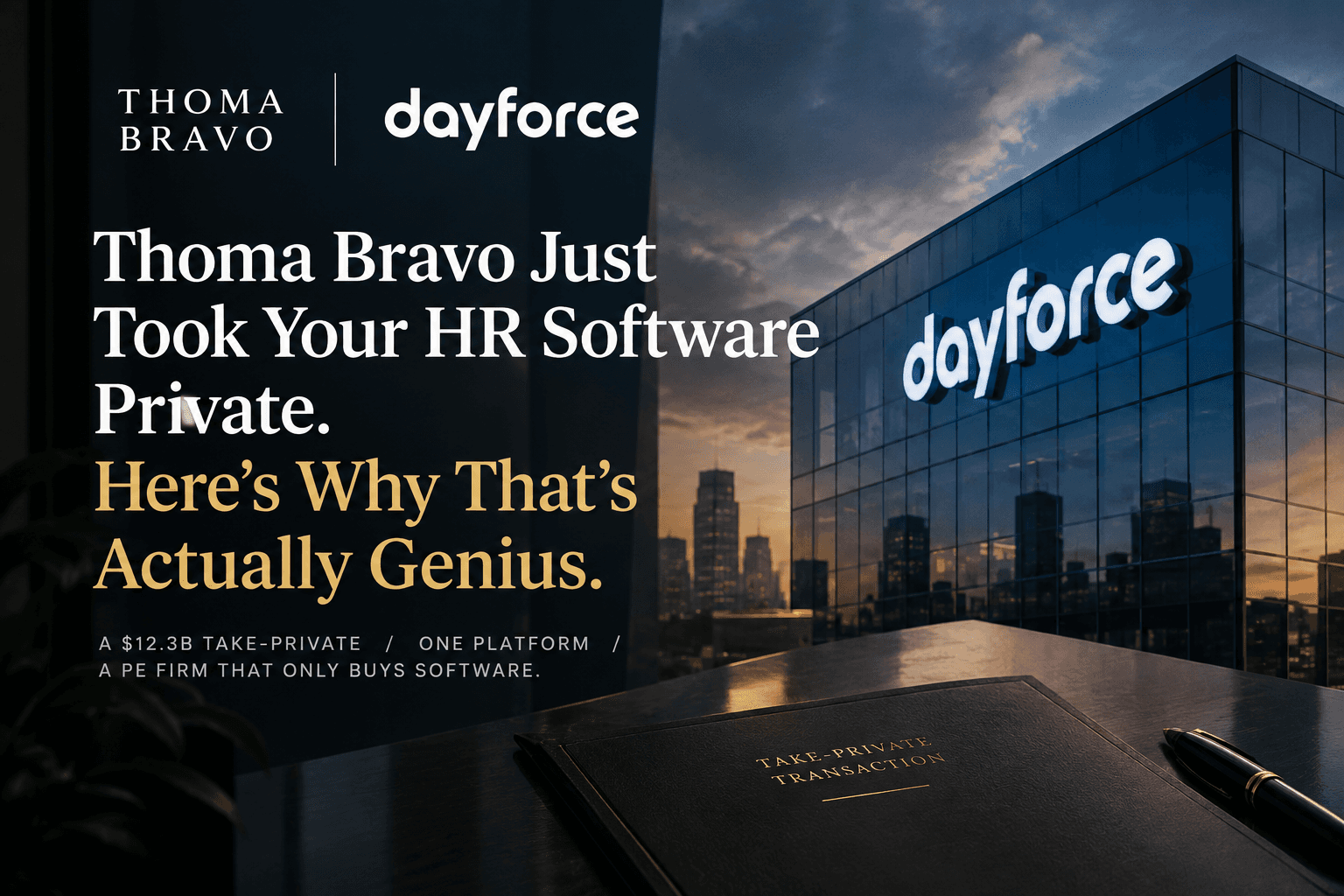
Thoma Bravo Just Took Your HR Software Private. Here's Why That's Actually Genius.
Private Equity
The Deck:
A $12.3B take-private, one unified platform, and a PE firm that only buys software. Dayforce never stood a chance and honestly? That's a compliment.
Thoma Bravo paid $12.3 billion to take Dayforce private in February 2026. That's not a typo. Twelve. Point. Three. Billion. For HR software.
Before you close the tab, stay with me. Because this deal is one of the cleanest examples of private equity doing exactly what it's supposed to do, and understanding it will make you genuinely dangerous in any finance interview.
What Even Is Dayforce?
Dayforce is the software that makes sure you get paid correctly, your shifts are scheduled, your tax forms are filed, and your HR team isn't drowning in spreadsheets. It does payroll, workforce management, talent, benefits, analytics, all in one platform. Thoma Bravo says it can replace up to 12 separate systems. That's the pitch.
Before the deal: 6,876 customers live on platform. 7.6 million employees globally running through its systems. $1.76 billion in cloud recurring revenue, growing at 16.3%. EBITDA margins at 28.5%.
This is not a struggling company. This is a very good company that the public market was sleeping on.
The Premium They Paid
Thoma Bravo offered $70 per share, cash. That's a 32% premium to where Dayforce was trading before deal rumours leaked on 15 August 2025. Shareholders voted yes in November. Deal closed 4 February 2026. Dayforce delisted from NYSE and TSX. Done.
The Abu Dhabi Investment Authority (ADIA) also came in as a minority co-investor. When sovereign wealth funds are at the table, the deal has credibility.
Why Thoma Bravo Specifically
Thoma Bravo isn't a generalist PE firm. They exclusively buy software businesses. That's it. That's the whole strategy. And they're very good at it.
Their playbook: find a software company with strong recurring revenue and high switching costs, take it private, make it more efficient, invest in product, grow it, exit at a higher multiple. Repeat.
Dayforce fits every criteria:
Recurring revenue. $1.76B in ARR means Thoma Bravo knows exactly what cash is coming in every quarter. That's the foundation for everything else.
Switching costs are brutal. Think about what it actually takes to rip out a payroll system. Data migration. Compliance risk. Retraining your entire HR team. Integration with every other system. Nobody does that unless they absolutely have to. That stickiness = pricing power = retention = predictable growth.
One platform to rule them all. Most companies still use different vendors for payroll, scheduling, talent management, analytics. Dayforce unifies it. That cross-sell opportunity is massive, if a customer is only using payroll, you can sell them five more modules without touching new-customer acquisition costs.
AI. Dayforce sits on a goldmine of workforce data - pay, hours, performance, scheduling, compliance. If you can build AI that automates anomaly detection, improves scheduling, gives managers real-time workforce insights, that's not a feature. That's a moat.
The Four Levers
Every PE value-creation plan runs on the same four levers. Here's how they apply to Dayforce:
Revenue growth. New logos, international expansion, bigger enterprise customers, and cross-selling to the existing base. The installed base is the low-hanging fruit, it's far cheaper to sell another module to a customer who already trusts you than to win a brand new one.
Margin expansion. Already at 28.5% EBITDA margins which is above average for enterprise software. Thoma Bravo will look at procurement, headcount discipline, sales efficiency, support automation. The goal isn't to slash and burn, it's to find where money is being spent without producing returns and redirect it.
Debt paydown. This deal used leverage, sponsor equity from Thoma Bravo plus third-party debt. As Dayforce generates cash flow, it pays down debt. Even if the company's enterprise value stays flat, reducing net debt means more of that value goes to equity. That's how PE math works.
Exit multiple. The endgame is selling or relisting at a higher multiple than they paid. That happens if Dayforce is bigger, more profitable, more AI-integrated and more deeply embedded in enterprise operations than it is today. Timeline: likely 4–7 years.
Who Wins, Who's Watching
Clear winner: Dayforce shareholders - 32% cash premium, immediate exit, no execution risk.
ADIA: Gets exposure to one of the most attractive software assets in enterprise tech without running the deal themselves.
Thoma Bravo: This works if they execute. The price is not cheap - $12.3B enterprise value on $1.76B ARR is a real multiple. They need to grow the business, not just cut it.
The Risks That Actually Matter
The competitive set is not friendly. Dayforce competes with Workday, SAP SuccessFactors, Oracle HCM, ADP. These are not small companies. They have deep customer relationships, large R&D budgets and the ability to price aggressively to protect market share.
Payroll can't fail. Unlike most software, payroll errors have immediate, legal, reputational consequences. A major outage or compliance failure could damage customer trust in ways that take years to repair.
AI has to actually work. Building AI features into HCM sounds great until an AI makes a payroll error, violates a labour law, or leaks sensitive workforce data. Dayforce is sitting on some of the most sensitive employee data that exists. That responsibility is significant.
Cost-cutting has a ceiling. There's a version of this deal where Thoma Bravo squeezes margins in the short term and weakens the product in the long term. If they underinvest in implementation quality, customer support or product innovation, churn goes up and the exit story falls apart.
The Rookonomy Verdict
This is textbook Thoma Bravo. Strong recurring revenue, mission-critical product, brutal switching costs, massive cross-sell opportunity, and a clear AI narrative to accelerate the multiple at exit. The 32% premium is high but not irrational, the public market was focused on quarterly noise while the long-term platform story was being discounted.
The question isn't whether Dayforce is a good asset. It clearly is. The question is whether Thoma Bravo can grow it without damaging what made it good: product reliability, customer trust, and the promise of one unified system that actually works.
If they do both, this is a case study that gets taught in classrooms. If they prioritise the financial engineering over the product, $12.3B is a very expensive lesson.
Audacious. Calculated. Watch this one closely.