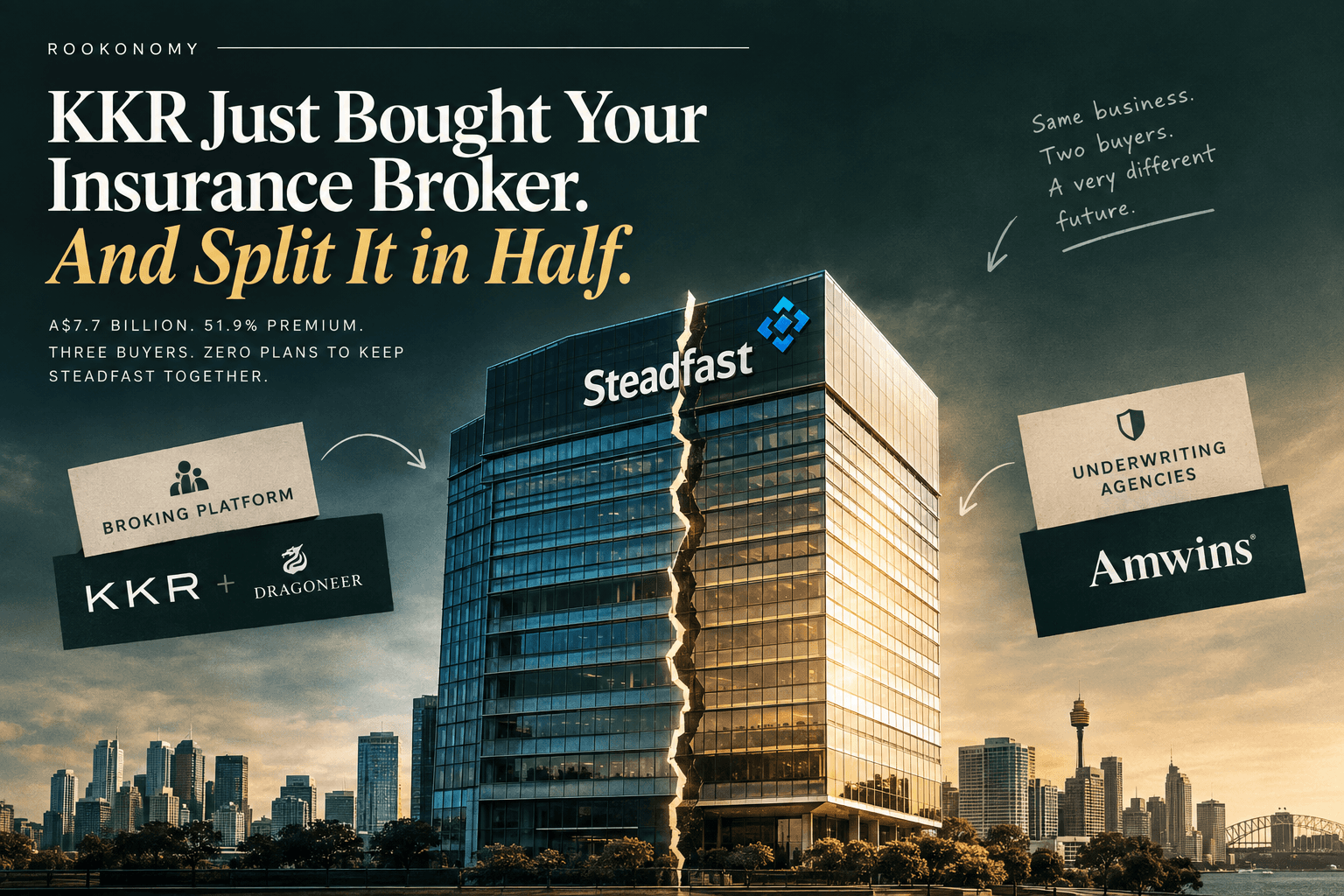
KKR Just Bought Your Insurance Broker. And Split It in Half.
Private Equity
KKR Just Bought Your Insurance Broker. And Split It in Half.
A$7.7 billion. 51.9% premium. Three buyers. Zero plans to keep Steadfast together. This isn't a takeover - it's a controlled demolition with a very expensive price tag.
Let's start with the number that matters: A$6.00 per share. That's what KKR, Dragoneer, and Amwins agreed to pay for Steadfast Group, which is Australia's biggest insurance distribution platform, in August 2026. It values the whole thing at A$7.7 billion, and it's a 52% premium to where Steadfast was trading before any of this leaked.
Fifty-two percent. That's not a buyout, that's a message. The message is: "we think this is worth a lot more than the market does, and we're willing to bet billions on it."
But here's where it gets interesting. This isn't a normal take-private where one firm buys a company, holds it for five years, and floats it again. This deal is a strategic break-up. From day one, the three buyers are planning to split Steadfast's two businesses, its insurance broking network and its underwriting agencies and hand them to completely different owners.
Think of it like buying a building with two profitable tenants, then immediately selling each floor to a different landlord. Except the building costs seven and a half billion dollars.
What Even Is Steadfast?
If you haven't heard of Steadfast, you've definitely used something built on top of it. When an Australian SME calls their insurance broker to renew their business coverage, there's a 40%+ chance that broker is in the Steadfast network.
Steadfast doesn't sell you insurance directly. It connects independent brokers to the big insurers, QBE, Allianz, AIG and gives them technology, negotiating muscle, and back-office support in exchange for network fees. It also owns equity stakes in 62 broker businesses directly. At 30 June 2026, the network included 419 brokers operating from 2,096 offices, generating A$13.2 billion in gross written premium. The underwriting agency arm added another A$2.5B on top of that.
Revenue hit A$2.1 billion in FY26, up 15.3%. EBITA was A$669.8 million. This is not a struggling company getting bailed out by private equity. This is a profitable, growing, recurring-revenue business being taken off the ASX because private buyers think they can unlock more value than public markets were allowing.
The Three-Headed Buyer
Here's what makes this deal genuinely unusual. There are three buyers, and each one wants a different piece:
Amwins gets the underwriting agencies. They're a specialist US-based insurance distributor who already knows this business inside out. For them, it's a strategic acquisition, they're buying Steadfast's 20 agencies, 24 brands, and A$2.5B in premium across niche lines like strata, cyber, marine, and construction.
KKR + Dragoneer get the broking platform, operating through an entity called Starboard BidCo. Dragoneer is a growth-focused investor that loves tech-enabled financial services. KKR brings the firepower. Committed equity, debt financing, regulatory experience, and a track record of building large-scale financial services platforms. Together they're betting on the broker rollup thesis.
The structure is almost elegant. Amwins is a specialist operator, they get the agencies. KKR and Dragoneer are distribution platform investors, they get the brokers. Everyone gets the business they're actually best positioned to run.
They Had to Work For It
One detail most headlines glossed over: the consortium didn't get this on their first try. Steadfast's board knocked back two earlier bids before accepting the third:
First proposal: A$5.50/share → Rejected
Second proposal: A$5.83/share → Rejected
Final offer: A$6.00/share → Accepted
That 50-cent gap between the first and final offer? Roughly A$540 million more the consortium had to commit. Steadfast's independent directors ran a real process, they weren't rolling over.
What's the Actual Thesis?
At 11.5× EBITA, this is not a cheap deal. So what are KKR and Dragoneer actually buying?
The broker rollup. Australia has hundreds of independent insurance brokers, many run by founders who'll eventually need a succession plan. KKR can use Steadfast's existing network relationships to keep acquiring them at modest multiples, fold them into a centralised structure, and extract higher margins across the combined base. PE firms have run this exact playbook in accounting, veterinary, and dental. Insurance broking is next.
Tech as a margin lever. Steadfast was already building the Steadfast OnePlatform, a modernised layer that automates renewals, claims, debtor management, and broker workflows. More than 13,000 brokers and insurers were already migrated onto elements of it by FY26. Private owners can accelerate this without worrying about quarterly earnings calls, cut admin costs, and extract more earnings from the same premium base.
International optionality. Steadfast had operations in New Zealand, Asia, the US, and the UK, which are all growing fast off a small base. Under private ownership, international expansion is no longer constrained by public market patience.
Who Wins, Who Doesn't
Clear winners:
Steadfast shareholders - they're getting a 52% premium in cash, no questions asked.
Amwins - they've just bought a ready-made Australasian underwriting platform without having to build it from scratch.
KKR's funds - they now have exposure to A$13.2B in gross written premium and a broker rollup machine.
Worth watching:
The independent brokers in Steadfast's network. They chose to affiliate because of relationship-based value and the tools Steadfast gave them. A PE owner optimising for margins may erode exactly what made the network attractive. If enough brokers defect, the premium base, the whole foundation of the investment will start to crumble.
Also worth watching: Australian public markets. This is another high-quality business leaving the ASX because global private capital is willing to pay more for it than domestic investors were. That trend isn't slowing down.
The Risks That Actually Matter
Broker retention is the big one. Steadfast's stickiness is relationship-driven. Change the economics too fast and you lose the thing you paid A$7.7B for.
Separation complexity is real. Splitting broking from underwriting agencies sounds clean on paper, but these businesses share technology, people, and distribution relationships. A clean separation could take years, and if it goes wrong, both buyers are worse off than if they'd never split it.
Regulatory approvals across five jurisdictions, which include, ACCC (competition), FIRB (foreign investment), New Zealand's OIO, UK's FCA, and Singapore's MAS. Any one of them can impose conditions or delays. Targeted close is December 2026, which is already tight.
Leverage is a quiet concern. At 11.5× EBITA, the consortium is writing an expensive cheque and will load the business with debt to make the equity math work. If interest rates stay elevated or earnings disappoint, that debt becomes uncomfortable fast.
The Bigger Picture
Reuters described this deal as "symptomatic of a persistent valuation arbitrage between Australian public markets and global private capital." Translation: the ASX is underpricing good businesses, and global PE is happy to pay a premium to fix that.
For Steadfast, the public market was discounting the stock due to company-specific uncertainty. The consortium looked at the same asset and decided to price what they think it's worth. At A$6.00 a share, they're betting that private ownership unlocks more value than Steadfast could ever create navigating quarterly expectations on the ASX.
Whether they're right will depend entirely on what happens to 419 broker relationships after the paperwork is signed.
Rookonomy Verdict: The strategic logic is real. Splitting a mixed operator into focused businesses under motivated owners is legitimately value-creative. The premium is steep but justified by Steadfast's recurring cash flows and rollup optionality. The risk is execution: broker relationships are personal, separations are messy, and five regulators add real timeline uncertainty. But KKR has done harder things. If they keep the brokers, the math works. If they don't, A$7.7B becomes the most expensive lesson in the limits of the rollup playbook.
Audacious, and probably right.
Sources: Steadfast Group FY26 Financial Results, Scheme Implementation Deed announcement (August 2026), Reuters, ASX regulatory filings. For educational purposes only — not financial advice.